

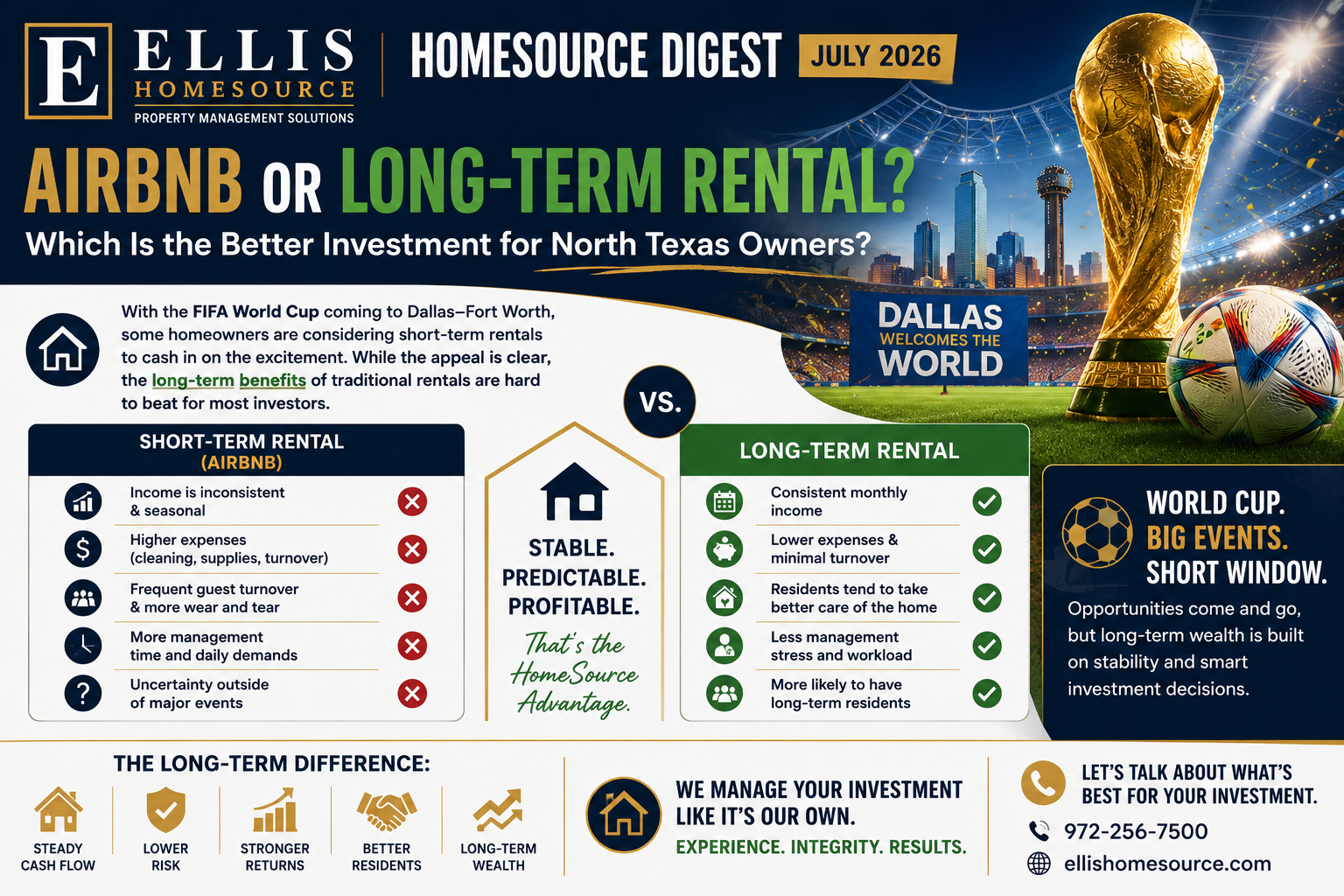
Airbnb vs. Long-Term Rental: Which Is the Better Investment for North Texas Homeowners?
We've Been Getting This Question a Lot Lately
Over the past several months, we've received an increasing number of calls from property owners asking the same question:
"Should I convert my rental property into an Airbnb for the World Cup, or should I keep it as a traditional long-term rental?"
It's an understandable question.
With Dallas-Fort Worth preparing to host some of the world's biggest sporting events and welcoming visitors from around the globe, many homeowners are wondering whether short-term rentals could provide a quick financial windfall. News stories about packed hotels, international tourism, and premium nightly rates have fueled interest in Airbnb and other short-term rental platforms.
At ELLIS HomeSource, we've had more conversations about short-term rentals in the last six months than we've had in years.
While there may be opportunities for some owners to capitalize on increased tourism during major events, it's important to separate temporary excitement from long-term investment performance.
The real question isn't whether you can generate higher nightly rates during a few weeks of World Cup activity.
The real question is:
Which strategy will provide the best long-term return while minimizing risk, vacancy, and headaches?
For most North Texas property owners, the answer continues to be a professionally managed long-term rental.
The Appeal of Airbnb and Short-Term Rentals
There's no denying that Airbnb has changed the real estate landscape.
At first glance, the numbers can look extremely attractive. Instead of collecting $2,500 per month in rent, an owner may see nightly rates of $250, $350, or even more during major events and assume the property will generate substantially higher profits.
And during high-demand periods like the World Cup, those numbers can be even more enticing.
However, revenue and profit are not the same thing.
Many owners focus on the potential income without fully accounting for the additional expenses, management requirements, and vacancy risks associated with operating a short-term rental.
A property charging premium nightly rates isn't necessarily producing a higher net return.
The Hidden Costs of Running an Airbnb
Unlike a traditional rental property, a short-term rental functions much more like a hotel business.
Owners are responsible for:
- Furnishing the entire property
- Replacing furniture, linens, and household items
- Paying utility bills
- Providing internet and streaming services
- Managing guest communication
- Scheduling frequent cleanings
- Restocking supplies
- Handling check-ins and check-outs
- Addressing maintenance requests on short notice
Every guest turnover creates additional work and additional costs.
A long-term resident may occupy a property for two or three years with relatively minimal management. An Airbnb property could experience dozens of guest turnovers during that same period.
More guests typically mean more wear and tear, more maintenance, and more opportunities for problems.
Occupancy Is Never Guaranteed
One of the biggest misconceptions about short-term rentals is that properties stay booked year-round.
The reality is very different.
Like hotels, Airbnb properties experience seasonality.
Some months perform exceptionally well. Others don't.
Demand can fluctuate due to:
- Local events
- Tourism trends
- Economic conditions
- Competition from other Airbnb hosts
- Hotel pricing
- Seasonal travel patterns
Many owners focus on what they could earn during their best month while overlooking what happens during their slowest months.
The World Cup may create a temporary surge in demand, but what happens after the final match?
What happens during slower travel periods?
What happens when thousands of other homeowners are competing for the same guests?
Unlike a traditional lease that generates consistent income every month, short-term rental income can vary dramatically from one month to the next.
For many investors, that uncertainty creates unnecessary risk.
Why Long-Term Rentals Continue to Win
At ELLIS HomeSource, we've managed rental properties through economic booms, recessions, housing shortages, and changing interest-rate environments.
One lesson remains constant:
Stable occupancy is one of the most powerful drivers of long-term investment success.
A long-term lease provides something every investor values:
Predictability
When you secure a qualified resident on a 12-, 18-, or 24-month lease, you know exactly what income to expect every month.
There are no concerns about weekend bookings, tourism cycles, seasonal fluctuations, or special events.
The property generates income every day of the year.
That consistency allows owners to budget more effectively, manage expenses more confidently, and build wealth over time.
Better Residents Often Mean Better Outcomes
One of the biggest advantages of long-term leasing is the quality of the resident relationship.
Long-term residents view the property as their home.
They establish roots in the neighborhood. They build relationships with neighbors. They become invested in maintaining the property and preserving the community.
As a result, they often take better care of the home than a revolving door of short-term guests.
No investment strategy completely eliminates risk, but properties occupied by long-term residents generally experience:
- Less wear and tear
- Fewer maintenance issues
- Lower turnover costs
- Reduced vacancy
- Greater overall stability
In many cases, the best resident is the one who stays for several years.
The Most Expensive Word in Real Estate: Vacancy
Professional property managers understand a simple truth:
Vacancy is expensive.
Every day a property sits empty, owners continue paying:
- Mortgage payments
- Property taxes
- Insurance
- HOA dues
- Utilities
- Maintenance expenses
Meanwhile, no rental income is coming in.
Long-term leases help minimize this risk.
Rather than constantly searching for the next booking, owners can focus on collecting consistent rent and protecting their asset.
For many investors, avoiding just one vacancy period can outweigh the potential gains from chasing higher nightly rates.
What About the World Cup?
This is the question we're hearing most often right now.
As Dallas-Fort Worth prepares to host World Cup matches, many property owners are considering whether they should temporarily convert their homes into short-term rentals to capitalize on the influx of visitors.
Could some homeowners make additional money during the tournament?
Absolutely.
However, we encourage owners to view the World Cup for what it is:
A temporary event—not a long-term investment strategy.
The tournament will create a surge in demand for a matter of weeks.
Your investment property, on the other hand, is a long-term asset designed to generate income and appreciation for years or even decades.
Making a long-term investment decision based on a short-term event can often lead to unintended consequences.
Instead of asking:
"How much could I make during the World Cup?"
Consider asking:
"What strategy will generate the highest risk-adjusted return over the next five to ten years?"
For most North Texas investors, the answer remains the same: a professionally managed long-term rental occupied by a quality resident.
The ELLIS HomeSource Philosophy
At ELLIS HomeSource, our goal isn't simply to maximize rent for a few weeks.
Our mission is to maximize long-term returns while minimizing risk.
That means focusing on:
- Resident retention
- Low vacancy rates
- Property preservation
- Proactive maintenance
- Consistent cash flow
- Long-term appreciation
While short-term rentals may be appropriate for some properties, most North Texas homeowners achieve stronger results through stable, professionally managed long-term leasing.
The investors who consistently build wealth aren't chasing short-term trends.
They're focused on protecting their assets, maintaining occupancy, and allowing time to work in their favor.
Final Thoughts
The excitement surrounding the World Cup will come and go.
The fundamentals of successful real estate investing remain remarkably consistent.
Quality residents, stable occupancy, controlled expenses, and long-term ownership continue to be the foundation of wealth creation.
Before converting your property into a short-term rental, take time to evaluate the full picture—not just potential revenue, but also the costs, risks, management demands, and vacancy exposure.
If you're considering renting out your property and want help determining the best strategy for your specific situation, the team at ELLIS HomeSource is here to help.
We'd be happy to provide a professional rental analysis and discuss whether a long-term or short-term approach best aligns with your investment goals.