

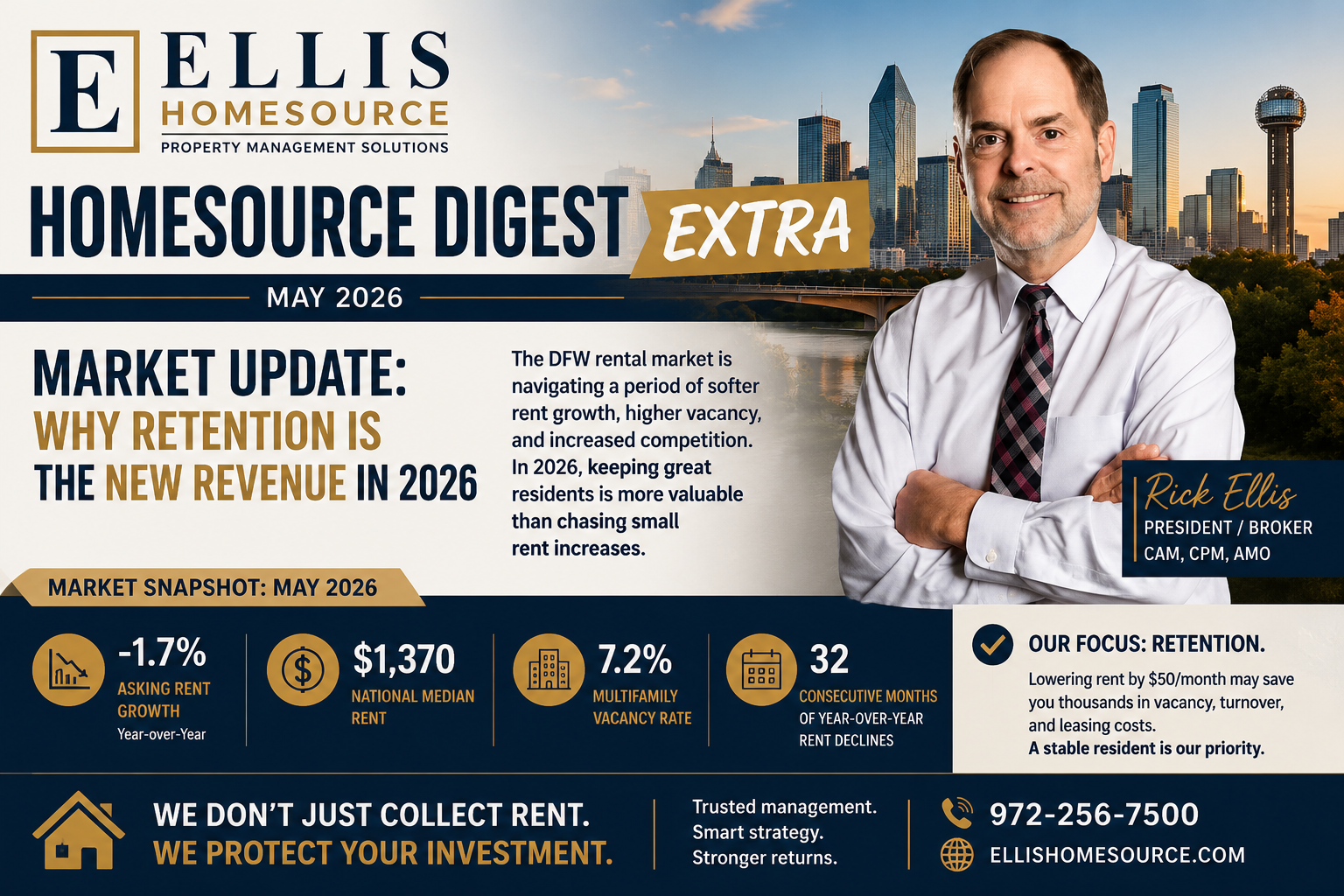
HomeSource Digest “EXTRA” — May 2026
Market Update 2026: Why Resident Retention Matters More Than Rent Increases
What Is Happening in the DFW Rental Market in 2026?
The Dallas-Fort Worth rental market is experiencing a period of softer rent growth due to a large wave of new housing supply entering the market. While DFW remains one of the strongest long-term markets in the country, higher vacancy rates and aggressive apartment concessions are making resident retention more valuable than aggressive rent increases.
For many property owners in 2026, keeping a quality resident may generate stronger long-term returns than risking vacancy for a small rent increase.
To Our Valued Property Owners,
As we distribute your May 2026 rental proceeds and reports, the team at ELLIS HomeSource Property Management wants to provide a transparent look at the current North Texas rental landscape. Every month, we analyze rent trends, vacancy data, and leasing activity to ensure your investment remains positioned for long-term success.
To understand today’s rental market, we first need to look back at the unusual cycle that shaped it.
The “Golden Era” of Rental Growth (2020–2023)
Between 2020 and 2023, the rental market experienced historic rent growth fueled by unprecedented household formation and limited housing inventory.
During that period:
- Roommates split households during and after lockdowns
- Migration into Texas accelerated
- Rental demand significantly outpaced supply
- Property owners experienced double-digit rent increases
However, that demand surge also triggered a massive wave of new housing construction across the country.
Many of those projects were delayed by supply chain disruptions and labor shortages, causing a backlog of inventory that finally delivered between 2023 and 2025.
In 2025 alone, the United States saw approximately 1.6 million housing completions nationwide, including multifamily and manufactured housing.
Why Are Rents Softening in 2026?
The rental market is now absorbing the significant amount of new housing inventory delivered over the last 24 months.
Several factors are contributing to softer rent growth in 2026:
- Increased apartment supply
- Elevated vacancy rates
- Slower household formation
- Reduced legal immigration
- Higher competition among landlords and apartment operators
The result is a more competitive leasing environment across many major U.S. markets, including Dallas-Fort Worth.
National Rental Market Trends in 2026
Current national rental data shows:
- Asking Rent Growth: Approximately -1.7% year-over-year
- National Median Rent: Around $1,370
- Multifamily Vacancy Rate: Approximately 7.2%
- Trend: More than 30 consecutive months of year-over-year rent softness
This does not indicate a market collapse. Instead, it reflects a normalization period following several years of unusually aggressive rent growth.
What Is Happening in the DFW Rental Market?
Dallas-Fort Worth remains one of the strongest long-term economic regions in the country due to:
- Corporate relocations
- Population growth
- Job creation
- Business-friendly policies
However, DFW is not immune to current national rental trends.
Current DFW Rental Market Conditions
Rent Growth
DFW asking rents have generally mirrored national trends, showing approximately 1.7%–1.9% year-over-year softness in many submarkets.
Apartment Competition
Many new apartment communities across North Texas are currently offering:
- 6–10 weeks of free rent
- Reduced deposits
- Move-in specials
- Additional leasing incentives
While single-family rental homes are a different product category, they still compete against these aggressive concessions.
Vacancy Rates
Earlier this year, North Texas vacancy rates approached levels not seen in roughly two decades, creating increased competition for qualified residents.
Should Landlords Raise Rent During Lease Renewals in 2026?
Not always.
One of the biggest misconceptions in real estate investing is that every lease renewal automatically justifies a rent increase.
In reality, rental pricing should be determined by:
- Current market conditions
- Competing inventory
- Property condition
- Location
- Resident quality
- Vacancy risk
In today’s market, many homes are already priced near their realistic market ceiling.
Attempting to increase rent by $50–$100 per month may create unnecessary turnover risk if comparable homes nearby are leasing for less.
Is Lowering Rent Ever a Smart Strategy?
Yes — especially in a softer rental market.
At ELLIS HomeSource, our primary focus in 2026 is resident retention.
The most expensive word in property management is:
Vacancy
When a resident moves out, owners often face:
1. Lost Rental Income
Vacancy periods commonly create 30–60 days of lost income.
2. Turnover Expenses
Typical turnover costs may include:
- Paint
- Cleaning
- Flooring
- Repairs
- Landscaping
- Utility expenses
For many single-family homes, turnover costs can exceed $2,000–$4,500.
3. Leasing & Marketing Costs
Finding and screening a new resident also creates:
- Marketing costs
- Leasing commissions
- Administrative time
- Additional risk exposure
If reducing renewal rent by $50 per month keeps a quality resident in place, that decision may save thousands of dollars in turnover and vacancy costs.
In today’s market, stable occupancy is often more valuable than pushing for maximum short-term rent growth.
Why Resident Retention Is the New Revenue
In 2026, strong property performance is less about maximizing rent increases and more about:
- Minimizing vacancy
- Reducing turnover
- Retaining high-quality residents
- Protecting long-term cash flow
- Maintaining property condition
A consistently occupied property with stable residents often outperforms a higher-priced property experiencing frequent turnover.
Our Commitment to Property Owners
At ELLIS HomeSource, we do more than collect rent.
We actively manage:
- Leasing strategy
- Market positioning
- Resident retention
- Maintenance coordination
- Vacancy risk
- Long-term asset performance
By closely monitoring DFW rental trends and proactively communicating with residents, we help property owners navigate changing market conditions while protecting long-term returns.
Thank you for your continued trust in ELLIS HomeSource Property Management.
Frequently Asked Questions
Why are rents decreasing in 2026?
Rents are softening due to increased housing supply, elevated vacancy rates, and slower household formation after several years of aggressive rent growth.
Should landlords increase rent during renewals?
Only if the market supports it. In many cases, retaining a quality resident is financially smarter than risking vacancy for a small increase.
Is DFW still a strong rental market?
Yes. Dallas-Fort Worth remains a strong long-term market due to population growth, jobs, and corporate relocations, despite current short-term softness.
Why is resident retention important?
Resident retention reduces vacancy loss, turnover costs, leasing expenses, and property wear-and-tear, ultimately improving long-term profitability.